

Mental health treatment expands beyond clinical settings as needs grow
According to Mental Health America’s (MHA) State of Mental Health in America report 2025, approximately 23.40% of U.S. adults (over 60 million people) experienced a mental illness in the past year. For the 60 million U.S. adults navigating a healthcare system with only 28% of mental health needs met, the traditional clinical model is no longer the only, or most accessible, path to recovery.
The American healthcare system is experiencing workforce scarcity, and the healthcare sector is among the most affected. Yet, demand for mental health care is on the rise, especially among younger generations that still feel the impact of pandemic-era anxiety, paired with climate-related distress, housing instability, and rising inflation.
From this perspective, the situation looks dire. But it’s also an opportunity to discover other forms of mental health treatment that don’t necessarily take place in a clinical setting. Not everyone responds well to weekly therapy, and not everyone requires intensive, medicalized care to see meaningful improvement.
As a result, Service Dog looks at how individuals are turning to alternative, accessible approaches that complement or, in some cases, replace conventional treatment models.
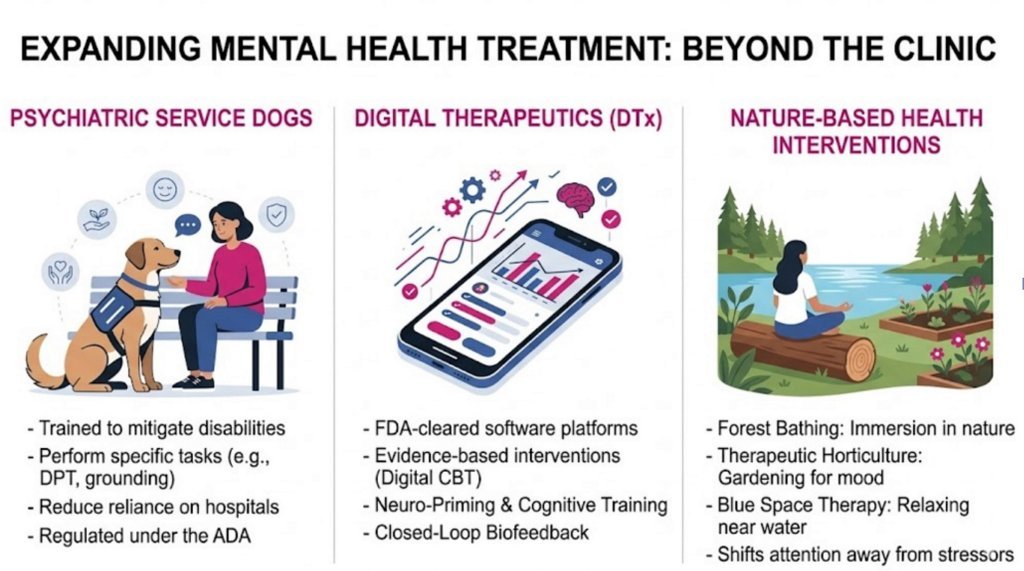
Three Non-clinical Mental Health Treatment Approaches
The more we learn about mental health, the more we see that the classic clinical approach doesn’t work for everyone. Since our brains are infinitely complex structures, mental health treatment should be designed to fit the individual and not the other way around.
While they may not completely replace treatment, nonclinical methods offer support and reduce patients’ reliance on hospitals or therapists’ offices. The following are three emerging approaches that, although unconventional, are gaining attention for their measurable impact on mental health outcomes.
1. Psychiatric Service Dogs
Psychiatric service dogs (PSDs) are highly regulated service animals. The vests they wear usually display additional information, such as the type of dog (medical alert, hearing, psychiatric, etc.).
These are legal service animals protected under the Americans with Disabilities Act (ADA). They are not pets. They are working dogs that assist with a range of needs, from mobility impairments to psychiatric conditions. They are allowed to accompany their humans wherever they go, including restaurants, stores, hospitals, airplanes, and more.
A trained service dog can offer support with a range of mental health conditions, including anxiety and panic disorders, PTSD, grounding tasks, emotional regulation, harmful or compulsive behaviors, etc.
These dogs are trained to perform specific tasks that mitigate a disability. Examples include deep pressure therapy (DPT) to abort panic attacks, grounding during PTSD flashbacks, and room searches to alleviate hypervigilance.
However, these animals are intended as complementary care rather than a primary clinical replacement. For patients navigating high-acuity cases, such as active psychosis or severe, treatment-resistant clinical depression, standardized medical intervention and pharmacotherapy remain the primary standard of care. A service dog functions most effectively as a support layer within a broader, multi-modal treatment plan.
2. Digital Therapeutics (DTx)
Digital therapeutics, or DTx, are FDA-cleared software platforms (usually smartphone apps) that deliver evidence-based interventions. They work by using real-time data to trigger biological or psychological changes through various interactions.
Here are the three primary ways they work.
Digital CBT (Cognitive Behavioral Therapy)
The software uses interactive lessons, thought records, and exposure exercises to rewire the brain’s response to triggers. Unlike a book, the app uses branching logic. It adjusts the difficulty and content based on your answers, ensuring you stay in the therapeutic zone.
Neuro-Priming and Cognitive Training
Some DTx, like those for ADHD or depression, use specialized, often gamified tasks to target specific brain regions. For instance, an app might use an Emotional Faces Memory Task to train the amygdala and prefrontal cortex to better regulate emotional processing.
Closed-Loop Biofeedback
These systems use external hardware like a smartwatch or a specialized sensor, to monitor physiological data in real time. If the system detects a stress spike or a nightmare pattern, it triggers an immediate intervention, like a vibration or a guided breathing prompt, to break the physiological loop before a full-blown episode occurs.
3. Nature-Based Health Interventions
Commonly known as ecotherapy or nature prescriptions, these are structured activities in natural environments designed to support mental health treatment and encourage well-being.
As the name suggests, these practices focus on interactions with nature, such as:
Forest Bathing
Originating in Japan, forest bathing involves immersing oneself in a natural environment through all five senses. Research from Qing Li from the Department of Rehabilitation Medicine, Graduate School of Medicine, Nippon Medical School in Tokyo, Japan, suggests that even a single two-hour session can reduce blood pressure and sustain those effects for several days.
While it can be practiced individually, it’s best to start with structured sessions led by certified guides. These follow a deliberately slow pace of less than a mile over two hours, and participants are encouraged to engage in sensory-focused activities, such as observing natural patterns, touching tree bark, or listening to ambient sounds.
The main purpose here is to shift attention away from stressors and toward present-moment awareness.
Therapeutic Horticulture
Gardening activities like weeding, planting, or mulching have a double effect. First, there’s the physical fitness aspect (movement in nature), but more importantly, research published in Systematic Reviews in 2024 shows that it reduces stress and anxiety, improves mood, and enhances overall mental well-being.
Engaging with plants and nature can also boost self-esteem and provide a sense of accomplishment. Again, this can be a solitary activity, but if you’re looking for connection, it’s best to join a community garden or a local organization that specializes in alternative methods of mental health treatment.
Blue Space Therapy
Humans have long had a strong relationship with bodies of water such as oceans, seas, lakes, and rivers. As Scripps Health points out, studies show that simply being near water in nature can raise dopamine levels while reducing stress.
The sound frequency of moving water, which is white noise, is linked to increased alpha brain waves, which are associated with a state of relaxed alertness. Water sports like surfing can also be used as mental health treatment sessions for people suffering from PTSD or developmental disabilities.
We Need More Diverse Mental Health Treatment Options
Expanding access to effective mental health treatment requires moving beyond one-size-fits-all models. As evidence continues to support alternative approaches, it’s essential to integrate more nonclinical methods into care strategies.
Mental health professionals have an opportunity to lead this shift by validating, recommending, and scaling diverse interventions that meet patients where they are, and ultimately close the gap between need and care.